Walking the aisles of the major design fairs this year, something caught the eye immediately: brass, but not in the usual way. Not just polished or brushed, not plated or lacquered. It had been bent, braided, looped, almost woven, into shapes that recalled textile patterns—herringbone, basket weave, interlacing grids that felt impossibly soft under the eye. You recognize it as metal, but it reads like fabric. There’s a tension there with woven brass textures. A quiet contradiction that makes a room feel considered, deliberate, alive.
It’s the kind of detail that makes other furniture feel inert. A walnut sideboard with brushed metal handles might be well-made, but it doesn’t spark conversation. Place it next to a brass screen twisted into a lattice of diamond patterns, and suddenly the wood hums with a new energy. The brass doesn’t just complement; it interacts. It catches light, throws shadows, and suggests rhythm.

Craft and Technique
The first question anyone asks is how. How do you make brass feel soft, pliable, textile-like? The answer is messy. There are no shortcuts in custom furniture. Artisans are folding, coiling, weaving by hand and machine, sometimes annealing the brass so it bends without breaking, then hammering it into patterns that play with scale and depth. The effect is almost painterly. You see texture before you see material.
Some pieces are subtle, almost invisible until the light hits them at a certain angle. Others are bold, entire surfaces treated as a woven field, repeating patterns that could easily exist as a rug or a tapestry. But they’re brass. Hard. Reflective. Somehow warm despite the metal.
It’s not just about decoration, either. Furniture legs, table aprons, headboards, cabinet faces—the brass does structural work, spatial work, as well as visual work. The way a woven brass panel wraps around a corner or peeks out from behind a glass top shows confidence. It says, design is not just applied on top; it can be the skeleton, the surface, and the pattern at once.
Scale and Environment
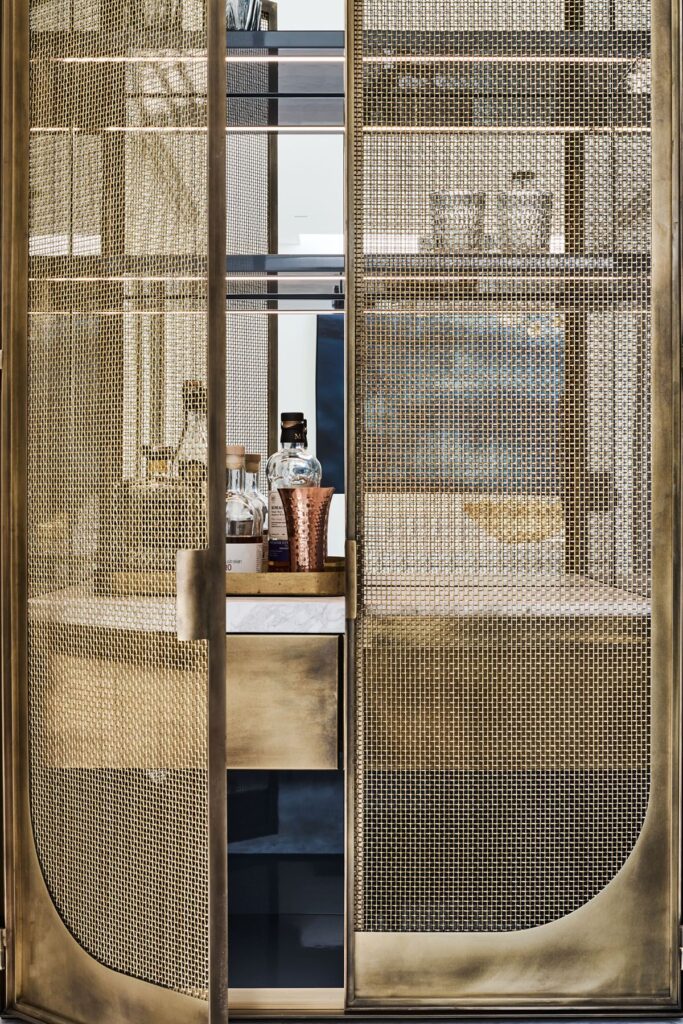
Some designers treat woven brass like wallpaper for furniture. A full armoire door covered in interlaced brass, repeating tightly, creates a surface that reads dense, tactile, even comforting. From a distance, the eye might read it almost like wood grain. Up close, it becomes a choreography of light and shadow.
Scale matters. A small side table with a subtle basket-weave inlay has a whispering presence. A large console with a bold herringbone lattice is almost aggressive, asserting itself in the room. There’s a push and pull between material weight and visual lightness. The eyes feel invited to trace patterns, to follow the loops and edges. There’s no instruction in this. You just do it, or you don’t.
Interaction With Other Materials
Brass alone is compelling, but paired with others it becomes narrative. Ebony, walnut, pale oak—warm woods ground it, give it earth and contrast. Marble tops, glass panels, leather straps, even stone accents—each reacts differently to the metallic weave. Some combinations feel studied; others feel inevitable.
There was a console at one fair, ebony frame, brass weave inset on three sides, white marble top. The light bouncing off the brass cast miniature grids onto the marble surface, like a second layer of texture that only existed when the room moved. It was fleeting, accidental, and precisely why these pieces feel alive.
Furniture That Breathes
The woven brass trend is fascinating because it doesn’t make furniture precious. It doesn’t feel like a museum object. You could sit next to it, lean on it, slide a hand across it. The brass invites touch, but it also resists it, keeps its shine, preserves its pattern. It’s furniture that has body and personality.
It’s not decoration for its own sake. The weave acts almost like punctuation. The piece reads, and the pattern gives it cadence. You can feel the designer’s hand, yes, but not in a prescriptive way. The pattern allows interpretation. It accommodates movement, shadows, light, and human presence.
Historical Echoes
Of course, woven metal isn’t new. There are echoes in mid-century brass grilles, in wrought-iron gates, even in older cabinet hardware. What feels contemporary is scale and subtlety. The designs at the 2026 fairs don’t mimic the past—they abstract it. They take the memory of a weave, the suggestion of textile, and amplify it into full-bodied furniture.
The effect is oddly tactile. You expect cold, reflective metal, but the eye reads warmth, softness, rhythm. There’s a quiet playfulness. The furniture acknowledges its own materiality while pretending, just slightly, to be something else entirely.
Light and Shadow
Woven brass is about light more than it is about surface. The interlacing patterns capture it, fracture it, project it. A pendant light with a basket-weave pattern across its dome doesn’t just illuminate; it writes across the walls in lace-like reflections. A cabinet front with woven brass glows differently at every hour of the day. Morning light is soft, afternoon is sharp, evening is golden. The room shifts without moving a thing.
Even in darker interiors, the material asserts itself. Matte finishes absorb and temper the shimmer. Polished strands catch. Shadows deepen. The furniture becomes kinetic without moving. A table leg, a screen, a headboard—suddenly there’s narrative, rhythm, performance.
A Question of Restraint
Not every designer knows restraint. A full brass weave on a bookshelf, coupled with woven brass legs, glass shelves, marble tops, and metallic lighting can collapse under its own ambition. But the best pieces know when to whisper and when to speak. A single panel, a portion of the apron, a backlit lattice—these choices give the room breathing space.
It’s a balancing act. Scale, context, adjacent material—all determine whether a woven brass detail reads as poetry or ornament. Done right, it elevates. Done wrong, it distracts.
Human Presence
Woven brass pieces feel designed for human interaction. The weave encourages tracing with a finger. The gaps between strands create rhythm you want to follow. You want to stand close, to bend your eye along the curves and loops. The furniture demands engagement without demanding respect.
It’s ironic, in a way. Metal is hard, unyielding, and permanent. But here it is behaving almost like textile: flexible in appearance, responsive in presence, tactile in a very deliberate way. The result is furniture that’s alive. That dialogue between cold material and warm perception makes a room feel considered, even intimate.
Why It Resonates
There’s an innate appeal to woven brass right now because it embodies contradiction. Light and heavy. Hard and soft. Reflective yet grounded. Old technique, new application. It feels modern because it refuses literalness. The eye reads what it knows, and the brain has to adjust. It’s a small cognitive thrill.
In 2026, where trends feel fleeting, the woven brass motif persists because it’s about craft, scale, and presence rather than hype. It’s confident, but not performative. It allows furniture to speak for itself, to inhabit the room without screaming identity.

Tactility in a Digital Age
It’s worth noting the context. Interiors are increasingly digital, minimal, flat. Rendered images, smooth planes, synthetic finishes dominate. Woven brass interrupts that. It reminds us that furniture is tactile, sculptural, and physical. It insists on human presence. A brass weave responds to motion, light, air. Digital renderings can hint at texture, but they can’t replicate how the eye dances across metallic loops, how shadows fracture.
There’s a slight rebellion here. Not flashy, but present. Woven brass demands attention to the moment, to the body, to the environment. It’s material culture asserting relevance in a high-tech world.
Small Interventions, Big Effect
You don’t need a roomful to make an impact. A single cabinet door, a side table, a lighting fixture in woven brass can reframe the environment. Placement matters. Light, adjacent materials, scale—these determine whether the piece sings or struggles.
But the effect is disproportionate. A small brass weave can anchor a space, introduce rhythm, suggest texture elsewhere. Shadows, reflection, and the human eye complete the composition. In that sense, woven brass is not just surface—it’s an environmental device.
The movement toward woven brass textures in furniture is not a gimmick. It’s a reflection of curiosity, craft, and interaction. Designers at the 2026 fairs are taking a simple material and pushing it to do things it was never expected to do. Metal becomes textile, heavy becomes light, static becomes dynamic. The furniture isn’t just present in the room—it converses with it.
It is quiet, deliberate, tactile, and alive.