













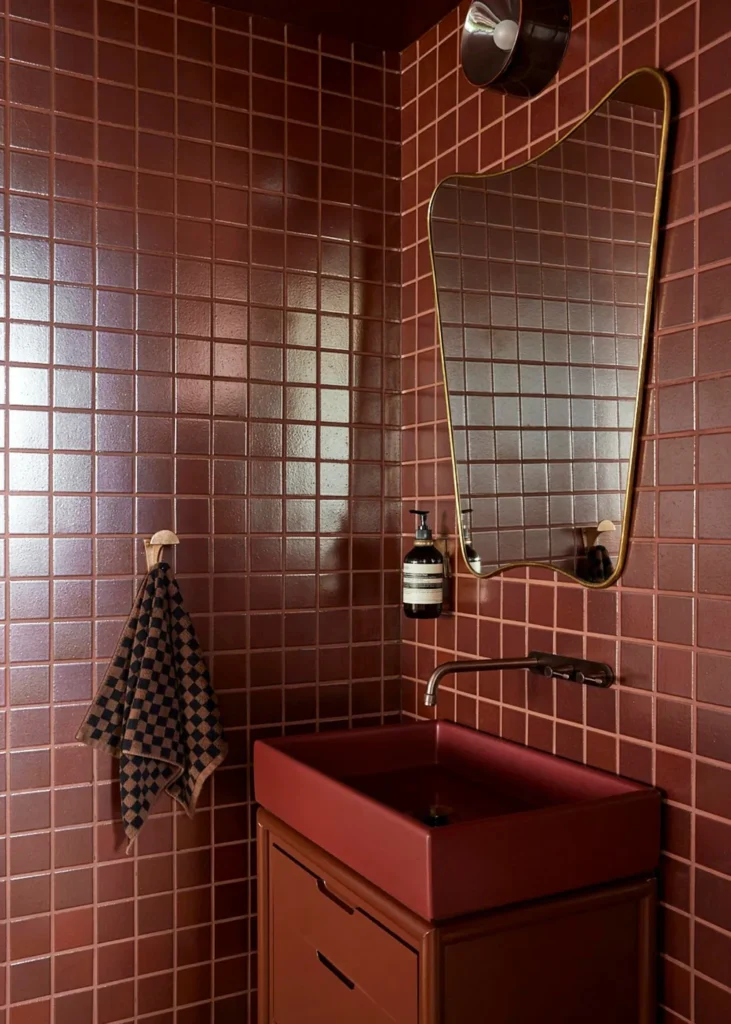
For decades, bathroom sinks were functional punctuation—white porcelain, anonymous, obedient. The faucet drew attention; the tiles and mirrors commanded it. Now, some sinks have decided they want their own voice, bathrooms are revolutionized with bold sink colors. Color is giving them agency, turning them from backdrop into focal point. A red basin doesn’t just exist in a room—it interrupts it, makes you pause, asserts itself without shouting. The neutrality of a pale room suddenly feels intentional because the sink is there, insisting that everything else bows slightly to its presence.
It is not bravado. A red sink in a pale gray bathroom reads audacious yet grounded. It’s a subtle lesson in visual hierarchy: even the smallest fixture can dictate perception. The white walls, the chrome, the tiles—they are not decoration so much as context. And because the basin is so small, the boldness feels calculated rather than overbearing. There’s psychology in that tiny scale, a quiet choreography between form, color, and expectation.
Pastels as Quiet Provocateurs
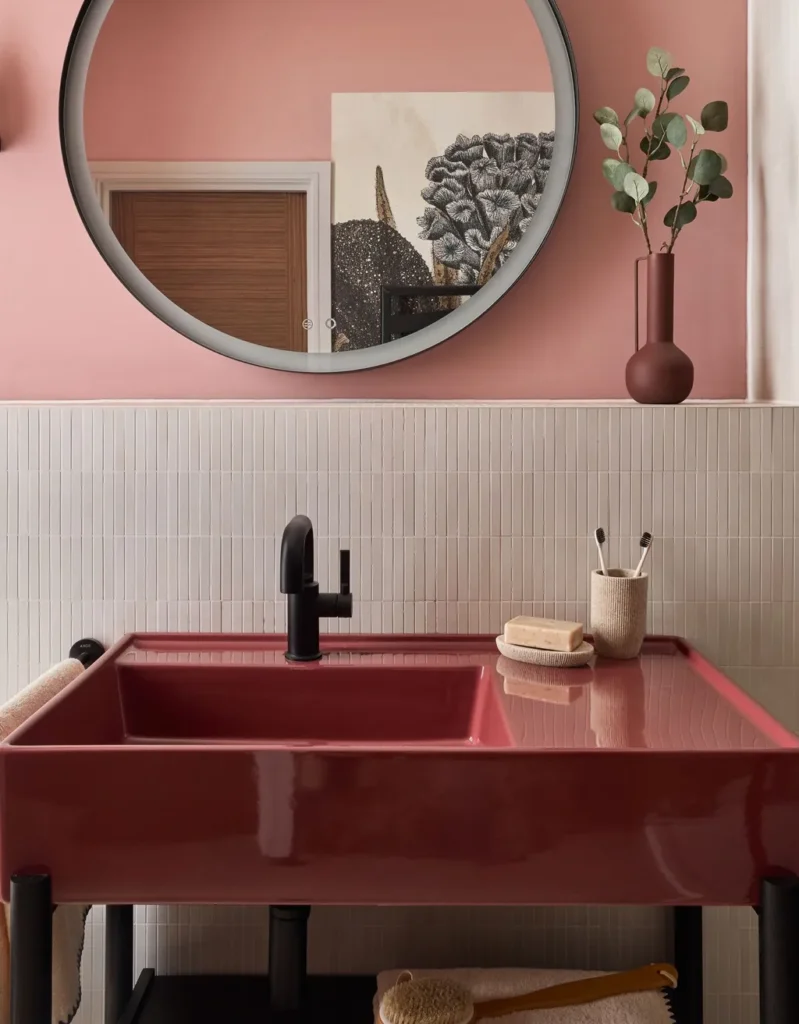
Not all attention-grabbing basins need to be dramatic. Pastels—pinks, peaches, mint greens—play with nostalgia but refuse to be quaint. They are entirely contemporary when juxtaposed with minimal hardware or restrained shelving. A pastel sink under a matte black faucet suddenly reads as witty, playful, clever in a way that feels instinctual rather than staged. These are the sinks you notice after a second glance, the ones that linger in memory because they are small, almost subversive interventions in an otherwise familiar space.
There is a subtlety in scale, in tone, in finish. A matte blush basin has a different emotional effect than glossy; mint green against white tile feels airy, against deep wood it feels anchored. Designers are no longer afraid to let a small surface dictate the narrative of an entire room. The basin is the point of reference, the anchor for choices in tile, lighting, and accessories. It does not compete—it organizes.
Greens That Ground
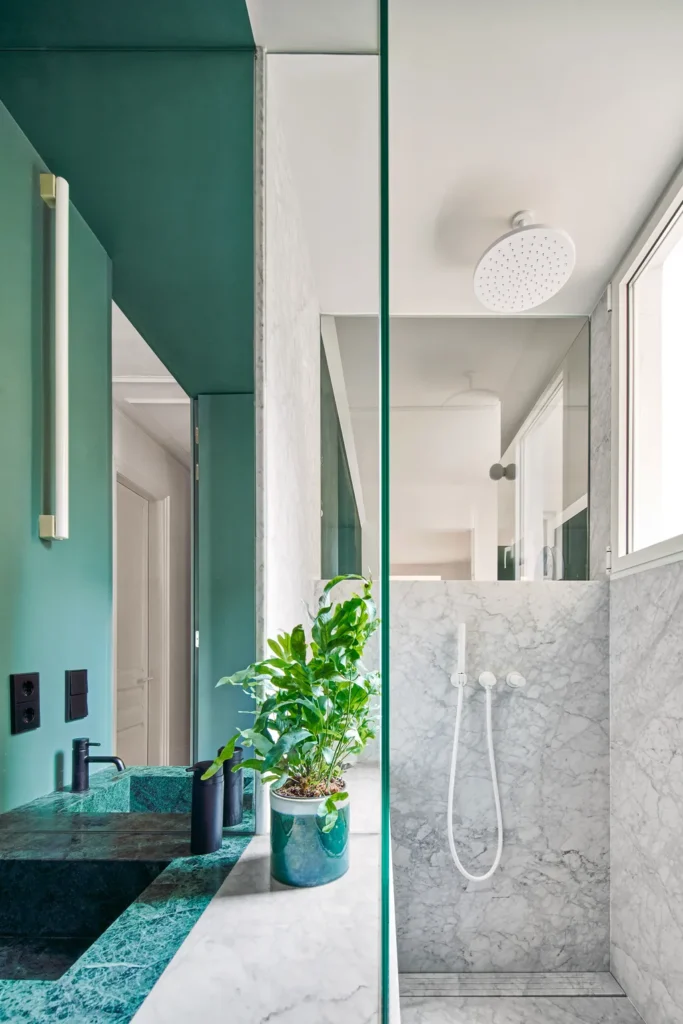
Earthy greens, mineral tones, and deep mosses operate differently from pastels or reds. They are quiet yet assertive, the opposite of attention-seeking in the traditional sense. A deep green basin absorbs light, creating depth, shaping reflections, softening shadows. Unlike white, it gives a room weight without heaviness. The presence of color changes how the entire space reads—warmth, scale, perception of light—all respond to that single choice.
These tones work because they invite the room to participate rather than dominate it. A green sink does not scream; it observes, subtly asserting its own logic. In an era when bathrooms are treated as micro-retreats, these colors feel grounded, even meditative. The basin becomes a psychological anchor as much as a visual one.
Color as Spatial Logic
Bold sinks are about more than expression—they clarify. A single hue can define zones in a small bathroom. The sink becomes an organizational principle, drawing other design decisions around it: tiles, wallpaper, mirrors, lighting. White sinks were invisible; colored sinks reverse the hierarchy. The room responds. The eye travels differently. Movement and attention are directed.
This is why scale and context are crucial. A vivid red basin surrounded by pink tiles reads as costume, whereas the same red in a slate-gray environment becomes iconic. Subtlety is essential. The finish matters: matte softens, gloss amplifies. A green sink with a satiny finish reads differently under daylight than tungsten bulbs. Designers are thinking not just in terms of hue but in how color interacts with light, texture, and mood.
Retro References Without Nostalgia
There is a subtle retro undercurrent here. Pastel porcelain basins evoke midcentury homes without feeling literal. When paired with contemporary hardware and uncluttered surfaces, the effect is nostalgic yet modern, familiar but unexpected. The retro reference becomes shorthand: a nod to history that does not dominate, a whisper rather than a shout.
Even the bold jewel tones—sapphire, ruby, amethyst—take cues from midcentury palettes but in modern context. They introduce drama in a restrained way, lending a sense of intention and tactility that white porcelain can never convey. The sink becomes not just a functional object but a design instrument, small but central.
Functional Drama
What’s remarkable is how a tiny basin can recalibrate a room. It’s not theatrical for the sake of spectacle. The drama serves function. A red or jewel-toned basin clarifies hierarchy, anchors the eye, establishes mood. Pastels soften the space, encourage a lighter emotional register. Earthy tones stabilize and ground. The sink is both punctuation and structure, modest in scale but mighty in influence.
Designers are increasingly aware of this. A sink’s color dictates furniture finishes, tile choices, and even lighting strategy. The eye reads the room differently; attention and movement are choreographed without physical barriers. A single hue turns a bathroom from incidental to deliberate.
Light as Amplifier
Colored basins are not static; they respond to light. Jewel tones shift from rich and saturated to muted depending on time of day. Pastels glow differently in natural versus artificial light. Even subtle differences in finish—matte versus gloss, textured versus smooth—affect perception. The sink becomes an evolving actor in the room, a fixture whose personality changes depending on moment and mood.
This dynamism is part of the appeal. White basins are neutral, predictable. Colored basins are alive. They absorb, reflect, and interact, influencing how the body inhabits the room. The choice of color becomes spatial, architectural even, a quiet intervention with outsized effect.
Small Scale, Big Impact
There is a paradox in all of this. The sink is one of the smallest surfaces in a bathroom, yet its impact is disproportionate. It governs perception, defines rhythm, establishes emotional register. The tiniest basin can shift the tone of the entire room. And because it is small, designers can take risks they might avoid with walls or cabinetry. Bold choices feel contained, adventurous without excess.
It is an intelligence of restraint. A red sink does not require matching accessories. A pastel basin does not need wallpaper in the same hue. The design works because the sink itself is a microcosm of intention. It suggests, implies, anchors, without needing decoration to validate it.
Beyond Trend
This is not about novelty. Colored sinks are not a fad to be adopted and discarded. They reflect a broader design principle: even functional surfaces deserve consideration. Bathrooms have been relegated to utility; now, designers are asserting that utility can also be expressive, that a tiny fixture can carry emotional weight. Color becomes a tool of perception, scale, and rhythm.
A well-chosen basin affects how a space feels, how it is used, and how it is remembered. It can introduce drama, calm, or playfulness, all through subtle interventions in hue, finish, and context. It asks more of the observer, and rewards more in return. It makes the ordinary extraordinary.
Small Gesture, Large Effect
Ultimately, the movement toward bold sinks is less about spectacle and more about intelligence in design. It’s a recognition that even the smallest element can dictate experience. Function and emotion coexist in a tiny porcelain bowl. That is what makes it compelling, what makes it modern, and what makes it hard to ignore. The sink is speaking. Finally.