There was a long stretch when upholstery tried to behave. Neutrals dominated. Texture replaced color. Bouclé stood in for personality. Everything was meant to calm, soften, disappear politely into the architecture. Furniture became background. You could describe the room, but you’d struggle to remember a single chair. That period is ending with bold textiles emerging in the current trend.
Walk through the current design fairs and bold textiles are everywhere—on sofas, dining chairs, headboards, benches, custom indoor and custom outdoor furniture. Saturated velvets. Graphic jacquards. Oversized plaids. Florals that feel closer to fashion than interiors. Furniture is dressed again, unapologetically. And it’s changing how rooms behave.

Upholstery as Attitude
Bold textiles don’t whisper. They assert. A chair upholstered in a dense cobalt velvet doesn’t wait to be noticed. It announces itself. Same with a sofa wrapped in a high-contrast pattern or a dining chair covered in a textile that looks more runway than living room.
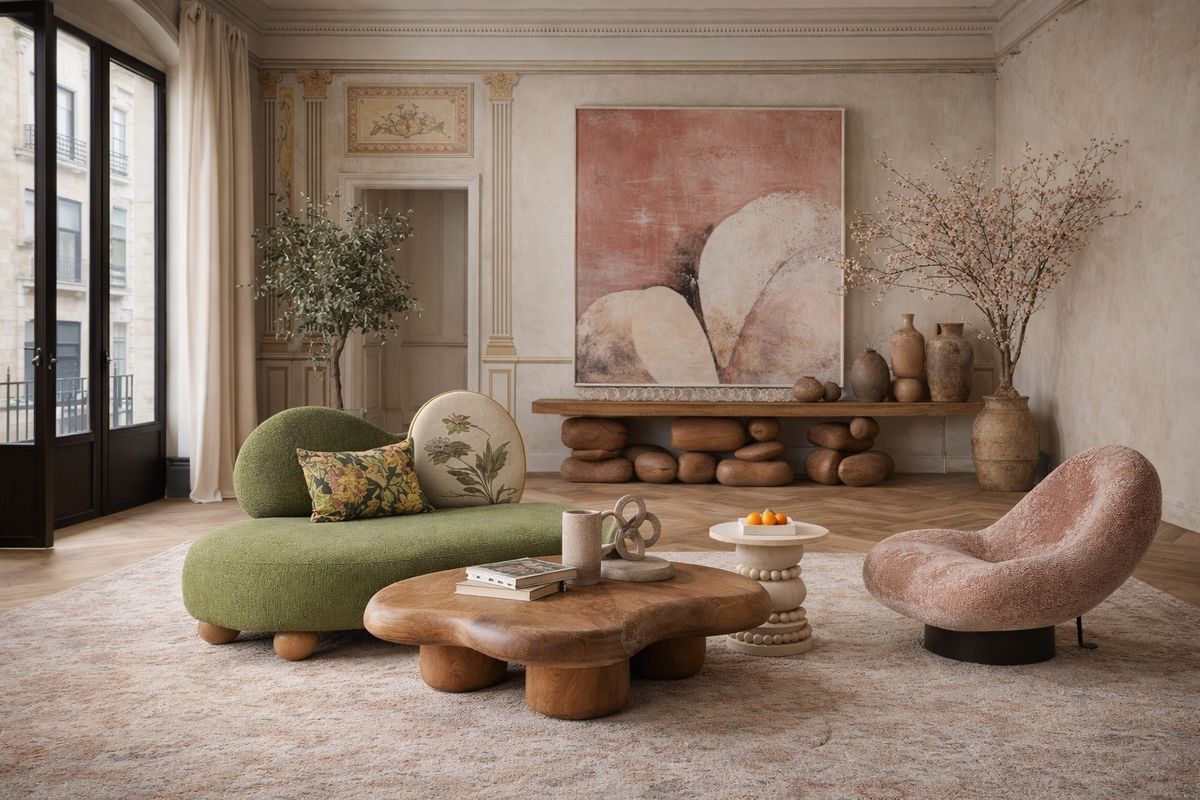
What’s interesting is that the forms themselves are often restrained. Clean silhouettes. Familiar proportions. The drama comes entirely from the fabric. Designers seem to understand that the power is in contrast: quiet shape, loud surface. Furniture that knows when to speak and when to step back.
There’s confidence in that. And a little defiance.
Pattern That Moves the Room
Patterned textiles change how a room moves. The eye doesn’t land and rest—it travels. Stripes elongate. Large-scale florals slow things down. Dense, repeating motifs create visual hum. A patterned sofa doesn’t just sit in a space; it reorganizes it.
This is why bold textiles can make minimal rooms feel intentional rather than empty. A simple white box with one aggressively patterned chair suddenly has a point of view. The furniture carries the narrative. The walls don’t have to.
And unlike art, textiles are physical. You sit on them. Lean into them. Live against them. That intimacy matters.
Color Without Apology
The current wave of bold textiles isn’t timid about color. Deep aubergine. Acid green. Rust red. Electric blue. Not accents—commitments. Upholstery that refuses to be balanced out or toned down.
What makes it work is placement. A saturated fabric on a single large piece often reads calmer than the same color scattered in accessories. One decisive gesture instead of many nervous ones.
There’s also a shift away from “safe” color stories. Instead of coordinating palettes, designers are letting fabrics clash slightly. Not chaos—friction. That tension keeps the room awake.
Texture Matters as Much as Pattern
Bold doesn’t always mean graphic. Sometimes it’s about surface. Cut velvet that catches light unevenly. Mohair that looks slightly unruly. Heavy linen with visible slubs. Textiles that refuse to lie flat or behave predictably.
These materials add depth without adding visual noise. A sofa upholstered in a rich, irregular textile can feel bold even in a single color. The interest comes from how it ages, creases, reflects light, absorbs shadow.
Furniture like this doesn’t photograph perfectly. Which is part of the point.

Furniture as Fashion
There’s an unmistakable crossover happening. Many of these textiles feel lifted straight from fashion collections. The scale of pattern. The color combinations. Even the willingness to be momentary.
Furniture used to pretend it was timeless. Now it’s allowed to be expressive. Dated, even, eventually. That’s not a failure—it’s honesty. Upholstery has always been replaceable. Treating it like clothing makes sense.
A chair in a bold textile doesn’t need to last forever. It needs to feel right now.
When Restraint Makes It Stronger
The most convincing uses of bold textiles tend to be singular. One sofa. One pair of chairs. One headboard. When everything is loud, nothing is. But when a single piece carries the weight, the room organizes itself around it.
This is where design literacy shows. Knowing when to stop. Knowing when a patterned chair needs a quiet floor, or when a saturated sofa needs a neutral wall behind it—not for balance, but for clarity.
Bold textiles reward confidence. Hesitation shows immediately.
Historical Echoes, Without Nostalgia
There’s precedent for all of this. Think of 1970s velvets, Art Deco upholstery, even older chintz-filled rooms that didn’t apologize for abundance. What’s different now is editing.
Patterns are larger. Colors are cleaner. The compositions feel intentional rather than inherited. Designers are referencing history without recreating it. The result feels contemporary, not costume.
A floral sofa today doesn’t read as grandma’s living room. It reads as a decision.
Emotional Impact
Bold textiles change how furniture feels emotionally. A neutral sofa is agreeable. A bold one has mood. Energy. Sometimes even humor. It affects how people sit, linger, talk.
There’s warmth in saturation. Comfort in density. A heavily upholstered chair in a deep color feels protective, enveloping. A patterned dining chair feels social, expressive, slightly theatrical.
Rooms with bold textiles feel inhabited, even when empty.

Living With Boldness
There’s a persistent fear that bold textiles are hard to live with. That they’ll tire quickly. That they’ll dominate. Sometimes that’s true. But often it’s projection.
Most people don’t tire of boldness—they tire of indecision. A well-chosen textile tends to settle in, become familiar, almost invisible over time. Meanwhile, the room retains its character.
And wear helps. Creases, fading, softening edges—all of it humanizes the fabric. Bold textiles age better than polite ones because they’re allowed to show it.
Not for Everyone—and That’s the Point
Bold textiles aren’t universal. They shouldn’t be. They demand taste, editing, and a willingness to commit. They expose uncertainty quickly.
But that’s why they matter now. Interiors have spent years smoothing themselves out, optimizing for broad appeal. Bold upholstery pushes back. It reintroduces subjectivity. Preference. Risk.
Furniture stops trying to please everyone. It starts saying something again.
Where This Is Going
The trend isn’t about excess for its own sake. It’s about expression. About allowing furniture to carry identity instead of outsourcing it to art or architecture.
Textiles are doing the heavy lifting because they can. They’re flexible, replaceable, emotional. They sit closest to the body. They absorb time.
Bold textiles don’t make furniture louder. They make it more present.
And in rooms that have grown increasingly quiet, that presence feels necessary.